 en
en  Español
 عربى
عربى
News ·
News ·
News ·
News ·
News ·
News ·
News ·
News ·
News ·
News ·
News ·
News ·
News ·
News ·
News ·
News ·

Posted by JUDUN
Does Less Closed Height Mean Less Lifting Range
Low installation height is a feature of an Ultra-Thin Hydraulic Cylinder but small size often brings up a real question: does a shorter closed height automatically mean a shorter lifting range?
The answer depends on how the cylinder's built. Closed height and stroke are. They are different things. Closed height tells how vertical space the cylinder takes up before it starts working. Stroke shows how far the piston can go. Product details show that some ultra-thin cylinders can still have a stroke even if they start very small.
Closed Height and Stroke Are Not the Thing
Closed height is the size of the cylinder when it is not working. Stroke is how far the piston can move. Extended height is the height when the piston is all the way out. The way these fit together depends on how the cylinder's made and how it is put in place.
- Height: Shows the smallest space needed to put the cylinder.
- Stroke: Shows how far the piston can move.
- Extended height: Shows the height when the piston is all the way out.
- Oil capacity: Shows how much oil is needed for the stroke.
One series of -thin cylinders has closed heights from 30 to 35 mm and a 10 mm stroke with capacities from 5 to 200 tons. The same series has extended heights from 40 to 45 mm. This shows that a short closed height does not mean the piston cannot move much.
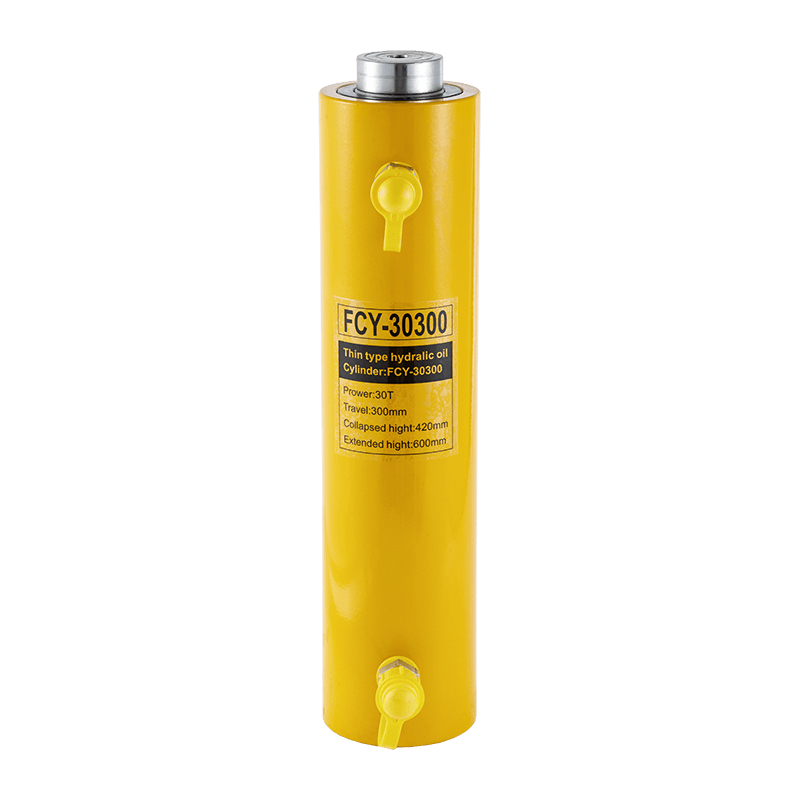
How Much Movement Can a Thin Cylinder Offer?
Stroke can be very different for profile hydraulic cylinders. Some models are made for short movement for exact lifting or positioning. Other low-height cylinders can move more.
For example one series has models with strokes from 6 mm to 16 mm. The 10-ton model has a 43 mm height and an 11 mm stroke. The 45-ton model has a 66 mm height and a 16 mm stroke.
Other designs have longer movement. One product family has a 10-ton model with 35 mm height and 35 mm stroke. A 50-ton version has 60 mm stroke from a 122 mm height.
These numbers show that closed height cannot tell how much the cylinder can lift. Stroke must be checked on the specification sheet.
Why Ultra-Thin Designs Often Have Shorter Strokes
Making a cylinder thin means using space carefully. The piston, the seals, the oil chambers the return parts and the structure all take up some of the space.
- Compact inside parts: room for the piston to move.
- Weight capacity: More force needs a bigger piston.
- Lifting tasks: Many ultra-thin models are for adjusting, aligning, spreading and starting to lift.
- Stability: A short stroke helps keep the load close to the base during lifting.
Some ultra-low cylinders show this clearly. A 150-ton model with a 30 mm height has a 10 mm stroke. A 100-ton model with a 41 mm height has a 15 mm stroke.
Does Higher Weight Capacity Change the Stroke?
Weight capacity can change the size of an Ultra-Thin Hydraulic Cylinder. Higher capacity models may need a piston and stronger parts. This can make the outside diameter bigger or the closed height longer.
Specifications show this clearly. One series covers from 5 to 200 tons. Closed height goes from 30 mm to 35 mm as the capacity increases. Stroke stays at 10 mm for all models.
Another ultra-flat cylinder series goes from 10 tons to 1000 tons. The lifting heights range from 7 mm to 17 mm. The minimum heights increase from 35.5 mm to 103 mm as capacity goes up.
What Specification Matters for the Real Job?
Choosing a low-profile cylinder by its smallest height can lead to the wrong choice. The movement needed should be calculated before thinking about space.
- Available space: Measure the gap under the load.
- Required lift: Find out how far the load needs to move.
- Weight capacity: Match the cylinder to the load and the working conditions.
- Pressure: Make sure the pump can give the needed pressure.
- Return system: Check if the model uses load return or spring return.
Ultra-low-height cylinders are often used for things like machine alignment moving structures lifting and working in tight places. Some flat models only have 0.24 inch of stroke. This shows they are for changes, not big lifts.
Short Height Does Not Mean Short Usefulness
A closed height and a short stroke can be together but they do different things. Ultra-Thin Hydraulic Cylinder designs focus on having space under the load. The stroke is what shows how much lifting can happen after installation.
The real question is not just how thin the cylinder is. Closed height, stroke, capacity, piston area, oil volume, pressure and return method all matter. A cylinder with 10 mm of movement can be perfect for aligning or starting to lift. Another job may need 35 mm or 60 mm of stroke.
Less closed height can give options, for installation without stopping useful lifting. The real sign of lifting power is the stroke, not the starting height.
Don't miss out. Contact us to get the latest information!

Products
Contact US
Taizhou Judun Tools Co., Ltd.
Jungang Village, Chumen Town, Yuhuan City, Zhejiang Province
Tel: +86-13967698556
E-mail: judungongju@163.com
Copyright © Taizhou Judun Tools Co., Ltd.. All rights reserved.
