 en
en  Español
 عربى
عربى
News ·
News ·
News ·
News ·
News ·
News ·
News ·
News ·
News ·
News ·
News ·
News ·
News ·
News ·
News ·
News ·

Posted by JUDUN
Long Stroke, Short Footprint: Multi-Section Jacks Explained
Long lifting travel usually requires a cylinder with enough physical length to accommodate the required stroke. That relationship becomes difficult inside machinery with limited mounting space. A Multi-Section Hydraulic Cylinder Jack takes a different structural approach by placing several hydraulic stages inside a nested assembly. Each section extends progressively, allowing the jack to achieve considerable travel without requiring the same length in its retracted state.
This telescopic arrangement makes stroke-to-height ratio a key product characteristic. Rather than focusing only on lifting capacity, users need to examine collapsed height, total stroke, extended height, stage count, oil capacity, and load behavior across the complete extension range.
How Multiple Sections Create Extra Travel
Each section of a multi-section cylinder occupies part of the overall body while retracted. Hydraulic pressure causes the stages to extend sequentially, with the nested sections moving outward as the cylinder approaches its full stroke. This design allows the extended length to greatly exceed the compact starting height.
- Two-stage construction: Suitable for applications requiring additional travel without an excessively long collapsed cylinder.
- Three-stage construction: Provides a greater stroke-to-retracted-length ratio for more demanding space restrictions.
- Four- or five-stage layouts: Can achieve substantially longer extension from a relatively compact starting dimension.
Commercial multi-stage cylinders are available with different configurations. Some hydraulic lifting products use two or three stages, while other designs offer two to five stages depending on the required stroke and installation dimensions.
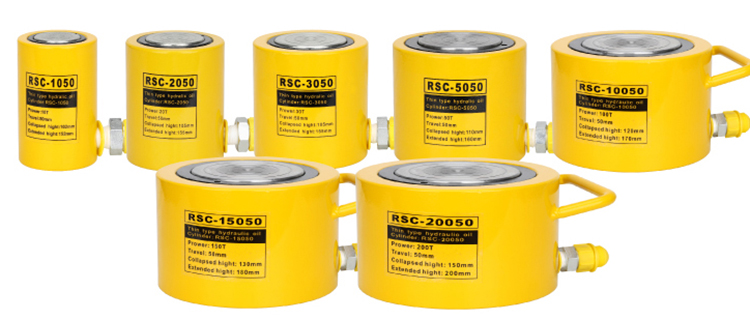
Collapsed Height vs. Extended Height
Two dimensions deserve particular attention: the minimum closed height and the maximum extended height. The difference between these values represents the usable extension range, although the rated stroke should always be checked separately because saddle height and other structural dimensions may affect the final working position.
- Collapsed height: Determines whether the jack can physically enter the available mounting area.
- Total stroke: Indicates the hydraulic travel available from the starting position.
- Extended height: Defines the maximum working reach of the complete assembly.
- Stage count: Influences how much stroke can be packaged into the available body length.
Published specifications illustrate the difference clearly. One multi-stage hydraulic jack series lists a 10-ton, two-stage model with a 49 mm stroke and 74 mm extended height, while a 30-ton, three-stage version provides a 50 mm total stroke with a 118 mm extended height. Larger models can provide substantially greater travel.
Does More Stroke Mean the Same Force Throughout?
Hydraulic force depends on pressure and effective piston area. Multi-section construction adds another variable because the active hydraulic area can change as different stages extend. This means the available force should be evaluated stage by stage rather than assumed to remain identical across the complete stroke.
Technical data from telescopic cylinder systems can list separate capacity and stroke values for individual stages. Such specifications help engineers understand how the cylinder behaves during progressive extension.
Load position also matters. A long extension increases the distance between the base and the load point. Proper alignment and stable load support therefore remain important throughout the lifting cycle.
Where Long-Stroke Compact Jacks Make Sense
- Vehicle lifting: Long travel can be packaged into restricted mounting spaces around heavy equipment.
- Industrial positioning: Multi-section cylinders can provide substantial movement without installing a conventional long cylinder.
- Heavy machinery: Telescopic construction suits equipment requiring considerable vertical or linear movement.
- Compact lifting systems: Short retracted dimensions can simplify integration into structures with limited clearance.
Some industrial telescopic cylinders offer strokes measured in several hundred millimeters, while larger customized designs can reach several meters. Available configurations vary considerably according to stage count, bore dimensions, pressure rating, and mounting arrangement.
What Should the Specification Sheet Reveal?
Capacity alone does not describe a Multi-Section Hydraulic Cylinder Jack. A useful specification sheet should show the relationship between each stage and the complete assembly.
- Rated capacity and working pressure
- Number of hydraulic stages
- Individual and total stroke
- Collapsed and extended height
- Oil capacity and port dimensions
- Return method and mounting configuration
The real value of a Multi-Section Hydraulic Cylinder Jack lies in how much movement can be achieved from its closed dimensions. Engineers dealing with long travel and limited installation length can use the telescopic structure to balance stroke, capacity, physical footprint, and working reach within a single hydraulic lifting system.
Don't miss out. Contact us to get the latest information!
Products
Contact US
Taizhou Judun Tools Co., Ltd.
Jungang Village, Chumen Town, Yuhuan City, Zhejiang Province
Tel: +86-13967698556
E-mail: judungongju@163.com
Copyright © Taizhou Judun Tools Co., Ltd.. All rights reserved.
